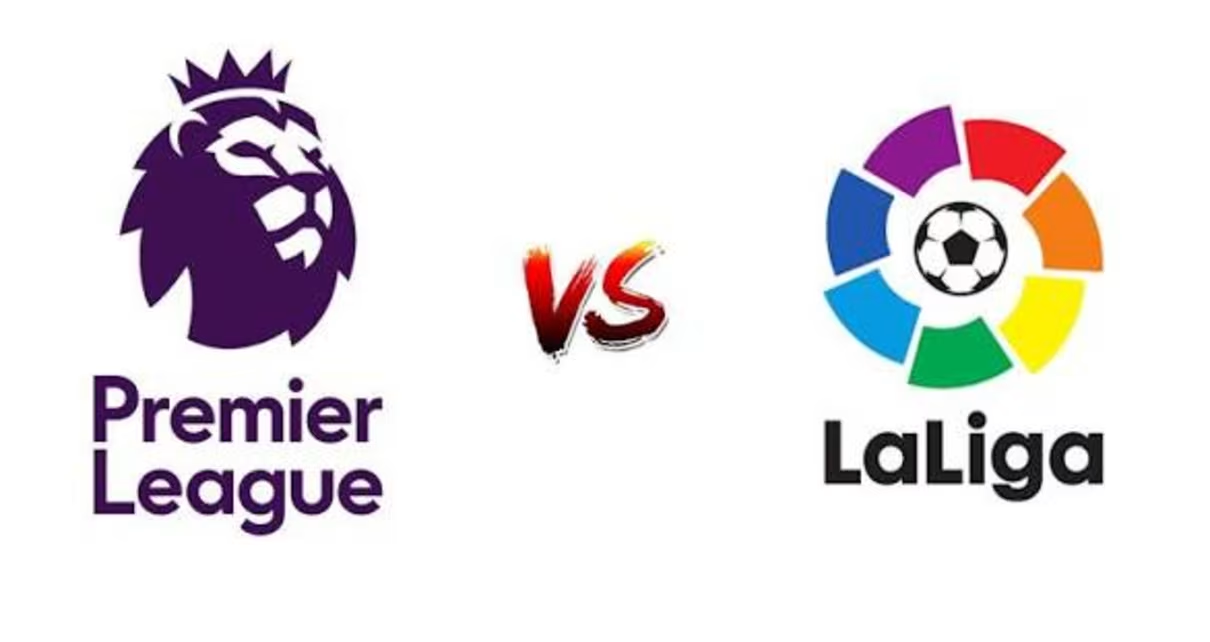
Is La Liga More Popular Than the Premier League?
No, not by the numbers. The Premier League is the more popular league worldwide, and it isn’t especially close. Premier League matches reach roughly 3.2 billion cumulative viewers per season across 212 countries. La Liga’s global audience sits at around 600 million viewers a season. That’s a gap of more than five to one. However, “popular” can mean different things depending on what you’re measuring, so let’s break down where each league actually stands.
Premier League Viewership: The Numbers
The Premier League is broadcast in more countries than any other football competition, and that reach shows up clearly in the data. It pulls in about 3.2 billion viewers across a season, with individual marquee fixtures like Manchester City vs Arsenal occasionally topping 50 million viewers on their own. The league also generated £6.3 billion in revenue in the 2023–24 season, the highest of any domestic football competition anywhere. Stadium attendance tells a similar story: Premier League grounds drew a record 15.4 million fans in 2024–25, more than any other league in the world.
Because English football is broadcast so widely and features so many recognizable clubs, it tends to be the entry point for new football fans in markets like the United States, Southeast Asia, and Africa. That built-in global habit is hard for any rival league to compete with.
La Liga Viewership: The Numbers
La Liga isn’t a small competition by any measure. It’s still the second most-watched football league in the world, ahead of the Bundesliga, Serie A, and Ligue 1. Its audience of around 600 million a season makes it a genuine global product, especially in Spanish-speaking markets and parts of Asia where the league has invested heavily in local broadcast partnerships. Meanwhile, single fixtures like El Clásico between Real Madrid and Barcelona can draw audiences comparable to a Premier League title-race weekend, since it remains one of the single most-watched club matches on the planet.
So while La Liga trails the Premier League on overall season-long reach, it doesn’t trail on peak moments. A blockbuster Clásico can rival anything English football produces in a single afternoon.
Why the Premier League Wins on Global Reach
Three factors explain most of the gap. First, the Premier League simply has more depth City, Liverpool, Arsenal, Manchester United, Chelsea, and Tottenham are all genuine global brands, not just one or two clubs carrying the league. Second, English is the most widely understood second language for football commentary and content, which makes the league easier to package for international broadcasters. Third, the Premier League’s broadcast deals are structured specifically to maximize international distribution, which is a big part of why it’s shown in more countries than any other league.
Check out our Javier Tebas Says the Infantino Era Is Over: Inside the FIFA Crisis
Where La Liga Still Has an Edge
Popularity isn’t only about total viewer counts. La Liga has historically produced more Ballon d’Or-level individual talent per era think the Messi-Ronaldo years and it still leans on that reputation for technical quality and attacking football. Younger stars like Lamine Yamal have kept that identity alive even without Messi or Ronaldo on the books anymore. For fans who care more about technical style than sheer scale, La Liga often wins the argument on quality, even while losing it on reach.
So, Which League Is More Popular in 2026?
If the question is which league is more popular overall, the Premier League wins clearly bigger global audience, wider broadcast reach, and higher revenue. But if the question is which league produces the single most-watched moments in club football, La Liga’s Clásico weekends can go toe-to-toe with anything the Premier League offers. Both leagues are genuinely global products; one just happens to be bigger across an entire season, while the other still owns some of the biggest individual match days in the sport.
Check out our Vinicius Junior Signs New Real Madrid Contract Until 2032